Skip to content
site-logo

Magic of Music Ed

Making Music A Bit More Magical!

  • Blog
  • Shop
  • Chamber of Freebies
  • About Me
  • Contact
  • Blog
  • Shop
  • Chamber of Freebies
  • About Me
  • Contact
Band

How To Teach Key Signatures

How To Teach Key Signatures

Key signatures are a fundamental musical concept that students need to understand to become competent and literate musicians. So why are key signatures so hard for kids to comprehend? When I ask my private students to identify the key signature, I usually get one of the following responses:

  • Blank Deer-in-Headlights Stare
  • Confusing Key Signature with Time Signature
  • Reading the Sharps and Flats Out of Order

If you’ve ever attempted to teach key signatures, you’ll know it can be a long process. Many music students will try to memorize their key signatures, but it’s always more effective to teach them the process of reading key signatures. When our students understand the music theory surrounding tonality and key signatures, they become confident, capable musicians. Let’s explore some resources and teaching strategies that will help your students identify the right key every time.

Concepts Students Need To Understand Before Learning Key Signatures

Students should be well into their music reading journey when key signatures are introduced. I like to start key signatures during the early years of my students starting their school band or strings program. This usually occurs some time in grades 4-6 for most school districts. When introducing key signatures, it is critical that your music students understand the following concepts first:

  • The Music Staff
  • Clefs
  • Line and Space Notes
  • Reading Notation
  • Intervals
  • Whole Steps and Half Steps

Intervals, whole steps and half steps are paricularly important for students to understand since they’ll utilize these concepts to identify the key.

If your students are fuzzy or shaky on any of the concepts I listed, stop here and address those areas first! Don’t know where to start? I have some amazing resources in my TPT store that will help your students understand these concepts in no time!

Start with Reading Sharps and Flats on the Music Staff

A promotional blog post image for a free printable worksheet titled Reading Sharps and Flats. The image features a pastel-colored ukulele, notebooks, and music theory worksheets on a wooden background. The worksheet helps students practice identifying sharps and flats on the music staff—a crucial skill before learning key signatures. Readers can download it for free from the Magic of Music Ed TPT store.
Get your students ready for key signatures with this free printable worksheet! It’s the perfect way to help them recognize sharps and flats on the music staff with confidence. Don’t miss out—download it for free from my TPT store!

Most music students don’t realize that sharps and flats can be placed on the music staff just like notes. It’s important to point out that accidentals (flats, sharps, and natural signs) can all be placed on the lines and spaces of the music staff just like musical notes can. From there, you can ask questions like “Is this accidental sign on a line, or inside a space?,” “Which line of the music staff is the flat sign on?,” or “Which note corresponds with the placement of this sharp?”

If you’re looking for a great practice worksheet for this, try this one from my TPT store!

Teaching the Order of the Flats and Sharps

Sharps and flats are read left to right in a key signature–just like reading a book! I like to use mnemonic devices to help my students remember the order of the sharps and flats:

Sharp Key Signatures

  • Order: B-E-A-D-G-C-F
  • Mnemonic Device: “Before Eating A Donut, Get Coffee First”

Flat Key Signatures

  • Order: F-C-G-D-A-E-B
  • Mnemonic Device: “Fat Cats Go Down Alleys Eating Birds”

2 Easy Tricks for Reading Key Signatures

A promotional blog post image for the Reading Major Key Signatures Google Slides lesson. The image features a laptop displaying a colorful slide about flat key signatures, with a simple trick for identifying them. The wooden background includes pastel stationery, emphasizing a music education theme.
Make teaching key signatures easy with this interactive Google Slides lesson! Perfect for band and orchestra students, this resource includes treble and bass clef versions to match different instruments. Plus, it comes with a self-grading Google Form assessment to check for understanding. Get it now on TPT and simplify your next music theory lesson!

Once students can remember the order of the flats and sharps, it’s time for them to learn how to identify the key signature. The simplest method is to teach your students these two rules:

Sharp Keys:

Find the last sharp in the key signature and raise it by a half step.

Example: In the key of D major the last notated sharp is C. When that note is raised by a half step, it reveals the key signature – D major!

Flat Keys:

Find the second-to-last flat in the key signature–that’s the key!

Example: In the key of  A♭ major, the second to last flat is A. That’s the key!

This method will work well for most of your learners–especially your analytical thinkers! Another method, ideal for visual learners, is to examine the circle of fourths and the circle of fifths.

Using the Circle of Fourths and the Circle of Fifths

A promotional blog post image featuring the title "The Circle of 4th’s & 5th’s" with a call-to-action to download free printable music theory handouts from the Chamber of Freebies. The image displays black-and-white worksheets for the Circle of Fourths and Circle of 5th’s, alongside a pastel-colored recorder, a succulent plant, and a notepad on a wooden background.
Looking for an easy way to teach key signatures? Download these free Circle of Fourths and Circle of 5th’s handouts! These printable visual aids are available in both treble and bass clef and can be used to help students understand how sharps and flats progress through key signatures. Perfect for color-coding activities and reinforcing music theory!

The Circle of Fourths and the Circle of Fifths are excellent visual aids that help students identify and remember key signatures. This is especially helpful for the visual learners in your classroom. The circle of fifths is designed to move clockwise in ascending fifths. Each step to the right introduces a new sharp in the order and shows students the corresponding major and relative minor keys. Likewise, the circle of fourths moves counterclockwise (to the left) and introduces a new flat in the order while also showing the major and relative minor keys.

Want a print-and-go visual aid containing the circle of fourths and the circle of fifths? Join the Chamber of Freebies! It’s my growing library of free music education resources. Inside, you’ll find a printable handout for the Circle of Fourths and Fifths that you can distribute to students or use as a visual in your classroom!
Creative Ways to Practice the Circle of Fourths and Fifths

  • Color-Coding: Have students use colored pencils or crayons to color-code the Circle of Fourths and the Circle of Fifths from The Chamber of Freebies. Encourage students to choose different contrasting colors for the flats side and the sharps side, as well as another color for the relative minor circle.
  • Play or Sing Through the Notes of the Circle: This is a nice warm-up that will help your students memorize the order of the circle of fourths and/or fifths. Start on C and play through each tone in the order of the circle. I like to do this on Orff xylophones, but you can also have students sing the pitches, which works well too. The best combination? Playing and singing the circle!

A Note About Enharmonics

Music students are usually surprised to learn that some scales can sound the same but have different names. These are called enharmonics, and it means that the same pitch can have two different names. It is easy for students to see enharmonic pitches when looking at the Circle of Fifths or Fourths or the white and black keys of the piano.

Examples:

  • C♯ major and D♭ major have the same pitches but are notated differently.
  • F♯ major and G♭ major are enharmonic equivalents.
  • The scales for A♭ and G# major are written differently but sound the same.

In the Circle of Fifths and Fourths, you’ll notice that enharmonic keys appear at the farthest points on the circle. This is a great opportunity to explain why some composers might choose one over the other—certain keys are easier to read depending on the instrument or ensemble!

Key Signatures & Tonality

A promotional blog post image for the Major or Minor? Google Slides Lesson. The image features a laptop displaying a slide comparing major and minor chords, with visual aids of piano keys. The wooden background includes sheet music and pastel stationery, reinforcing the theme of music education.
Help your students develop their musical ear with this engaging Google Slides lesson on Major and Minor tonalities. This interactive resource includes aural comparisons, music theory fundamentals, and embedded audio excerpts to make learning easy. Ideal for grades 5-8, this lesson introduces key signatures, whole and half steps, and major vs. minor scales without overwhelming students. Purchase it now on TPT!

Your music students may be wondering why they have to observe these different key signatures. The answer is that the key signature determines the tonality of a piece. Once students can correctly identify the key, it’s important to follow up by connecting that key to scales, arpeggios, chords, and tonality (major v.s. minor). Here’s how to introduce major and minor keys to students:

  • Play a C major and C minor scale back to back. Ask students how the scales sound and feel.
  • Explain that major and minor keys are tools that composers use to make music sound and feel different.
  • *Optional: Try showing students any video from Chase Holfelder’s Major and Minor playlist. He covers a lot of popular songs in minor keys that students will connect with right away.
  • Use the Major or Minor lesson slides available for purchase from my TPT store.
  • Have students practice playing major and minor keys on Orff Xylophones by creating major and minor improvisation stations, or by teaching students the C major and A minor scales.

Don’t forget to explain relative minor keys to your students! To find a relative minor key, go down three half steps from the major key.

Examples:

  • C major’s relative minor is A minor (no sharps or flats).
  • G major’s relative minor is E minor (one sharp: F#).

Other Teaching Resources for Key Signatures and Tonality

Looking for more resources? Check out the following teaching resources for key signatures and tonality!

Google Slides Lessons
A laptop screen displaying a Major Keys slide from a Google Slides lesson. The slide has a pastel purple background and describes how major keys sound happy, exciting, and uplifting. A hand and speaker icon visually represent listening. The Magic of Music Ed logo is in the corner.

Use these Google Slides lessons as your main teaching resource 👩🏻‍🏫

  • Major or Minor? Google Slides Lesson (Purchase on TPT)
  • Reading Major Key Signatures Google Slides Lesson (Purchase on TPT)

Boom Learning Resources
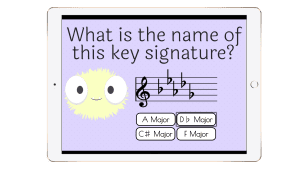
A tablet displaying an interactive key signature identification Boom Cards™ activity. The screen features a pastel purple background, a cute monster character, a musical staff with flats, and multiple-choice answer options for identifying the key signature.

Use these digital task card games to practice and reinforce key signatures and tonality! 🎶 

  • Major Key Signatures in Treble Clef Boom Cards (Purchase on TPT or Boom Learning)
  • Major Key Signatures in Bass Clef Boom Cards (Purchase on TPT or Boom Learning)

New to Boom Learning? Check out my blog post on using Boom Cards for Music Class! 

Worksheets & Teaching Bundles
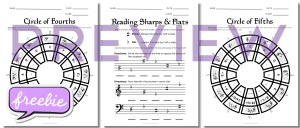
A preview of three printable music theory handouts for teaching key signatures. The worksheets include a Circle of Fourths, Circle of Fifths, and Reading Sharps & Flats exercise. The word "FREEBIE" is displayed on the image, indicating these are available for free.

Printables and resource bundles that give you everything you need! ⬇️

  • Reading Sharps and Flats Worksheet (Download Free on TPT)
  • Printable Circle of Fourths and Fifths (Available in the Chamber of Freebies–join for free now!)

Final Thoughts

When your students understand key signatures and tonality, they achieve a major milestone in music literacy. Remember to vary your lesson with music theory, listening, instrument playing, and singing to keep the lesson engaging and applicable to different learning styles.

Do you have a favorite trick or strategy for teaching key signatures? Leave a comment and let me know what works in your classroom! Don’t forget to join the Chamber of Freebies to grab the free printable Circle of Fifths and Circle of Fourths, along with other engaging music ed resources you can start using this week!

SHARE THIS
BandBeginning Music Teacherelementary musicFirst-Year Music TeachersGeneral Music ClassInstrumental Musicinstrumentskeykey signaturesLesson PlansMusic Lesson PlansMusic Lessons for KidsMusic TeacherMusic TeachersNew Music TeachersNotationorchestraReading Musictonality
About Suzanne

About Suzanne

My name is Suzanne. I am a music teacher from the state of NJ who is passionate about sharing creative ideas for the music classroom!

Related Posts

Teaching Music to Students with Hyperacusis
Is Music Class a Waste of Time?
Music Performance Assessment in the Classroom
An Easy Thanksgiving Music Activity for K-1

Leave a Reply Cancel reply

Your email address will not be published. Required fields are marked *

Recent Posts

  • Teaching Music to Students with Hyperacusis
  • Is Music Class a Waste of Time?
  • Music Performance Assessment in the Classroom
  • An Easy Thanksgiving Music Activity for K-1
  • Strategies for Teaching Note Values to Kids

Recent Comments

  1. SDelonas on How Music Education Benefits Students
  2. Monish Mehta on How Music Education Benefits Students
  3. SDelonas on How Music Education Benefits Students
  4. Binay Kumar Sarker on How Music Education Benefits Students
  5. Classroom Transitions in Elementary Music - Magic of Music Ed on 10 Tips for Teaching Music Effectively

Archives

  • November 2025
  • October 2025
  • September 2025
  • August 2025
  • July 2025
  • June 2025
  • May 2025
  • April 2025
  • March 2025
  • February 2025
  • January 2025
  • December 2024
  • November 2024
  • October 2024
  • September 2024
  • August 2024
  • December 2022
  • April 2022
  • February 2022
  • January 2022
  • December 2021

Categories

  • Advocacy
  • Assessment & Testing
  • Assessment & Testing
  • Back to School
  • Band
  • Blog
  • Boom Learning
  • Chorus
  • Classroom Management
  • Composers
  • Concerts
  • Cross-Curricular
  • December
  • Dynamics
  • Earth Day
  • Fall
  • Freebies
  • Games for Music Class
  • Genres
  • Holidays
  • Instrumental Music Teachers
  • Instruments of the Orchestra
  • Ledger Lines
  • Lesson Ideas
  • Listening Lessons
  • Lunar New Year
  • Music Activities
  • Music Community
  • Music Form & Analysis
  • Music Games
  • Music Genres
  • Music History
  • Music Teacher Tech Help
  • Music Theory
  • New Music Teachers
  • Note Reading
  • Note Values & Duration
  • Orchestra
  • Parents
  • Pitch
  • Quiet Music Lessons
  • Reading Music
  • Recorder
  • Rhythm
  • Seasonal
  • Social-Emotional Learning (SEL)
  • Solfege
  • Songs
  • Special Education
  • Spring
  • Students
  • Sub Plans
  • Summer
  • Surviving Until Break
  • Teaching Ideas
  • Teaching Orchestra Seating
  • Teaching Tips
  • Tempo
  • Testing Week
  • Time Signatures
  • Uncategorized
  • Virtual Field Trips
  • Winter
  • World Culture
About Me

About Me

Suzanne, Music Teacher
Hi, I’m Suzanne! I am a singer, flutist and most importantly a passionate music educator. I love putting creativity and imagination into my teaching and I can't wait to share my ideas with music teachers like you!

Popular Posts

10 Unique Themes For School Concerts
Chorus ➤ December 29, 2021

10 Unique Themes For School Concerts

Am I the only music teacher who thinks about themes for the next school concert when the first one finishes? If you read my blog post about concert planning, you’ll know I typically like to...

Read More
Teaching Music Genres in Music Class
Genres ➤ February 6, 2022

Teaching Music Genres in Music Class

Are you teaching music genres in your elementary music class? Including a variety of music genres in your teaching is essential to ensuring a rounded music curriculum. It also plays a role in your students...

Read More
10 Tips for Teaching Music Effectively
Back to School ➤ December 1, 2022

10 Tips for Teaching Music Effectively

Nine years. Sometimes I can’t believe I’ve been teaching elementary music this long. It’s been a crazy journey and there’s never a dull moment. There have been humps, bumps, and potholes but there have also...

Read More
Concert Planning for Music Teachers
Chorus ➤ December 1, 2021

Concert Planning for Music Teachers

It’s December 1st – you know what that means. For most music teachers, December marks the beginning of crazy season. The time of year where we feel anxious and stressed beyond belief. I know it’s concert season because I start to leave my belongings in other classrooms when I travel teach – oops! In any case, this year marks my tenth winter concert and I’ve learned a few strategies along the way. This blog post features 24 of my best concert planning tips!

Read More

Categories

  • Advocacy
  • Assessment & Testing
  • Assessment & Testing
  • Back to School
  • Band
  • Blog
  • Boom Learning
  • Chorus
  • Classroom Management
  • Composers
  • Concerts
  • Cross-Curricular
  • December
  • Dynamics
  • Earth Day
  • Fall
  • Freebies
  • Games for Music Class
  • Genres
  • Holidays
  • Instrumental Music Teachers
  • Instruments of the Orchestra
  • Ledger Lines
  • Lesson Ideas
  • Listening Lessons
  • Lunar New Year
  • Music Activities
  • Music Community
  • Music Form & Analysis
  • Music Games
  • Music Genres
  • Music History
  • Music Teacher Tech Help
  • Music Theory
  • New Music Teachers
  • Note Reading
  • Note Values & Duration
  • Orchestra
  • Parents
  • Pitch
  • Quiet Music Lessons
  • Reading Music
  • Recorder
  • Rhythm
  • Seasonal
  • Social-Emotional Learning (SEL)
  • Solfege
  • Songs
  • Special Education
  • Spring
  • Students
  • Sub Plans
  • Summer
  • Surviving Until Break
  • Teaching Ideas
  • Teaching Orchestra Seating
  • Teaching Tips
  • Tempo
  • Testing Week
  • Time Signatures
  • Uncategorized
  • Virtual Field Trips
  • Winter
  • World Culture

Shop

Chamber of Freebies!

Not a member?

Join now for more helpful blog posts, music ed resources and (best of all) access to the growing library of free resources for elementary music teachers 🙂

Sign me up!

  • Blog
  • Shop
  • Chamber of Freebies
  • Disclosures & Disclaimers
  • Privacy Policy
  • Contact Me
Copyright © 2026 | All Rights Reserved |